
Notes on "Pride"
After Susan Sontag, 'Notes on "Camp" (1964)

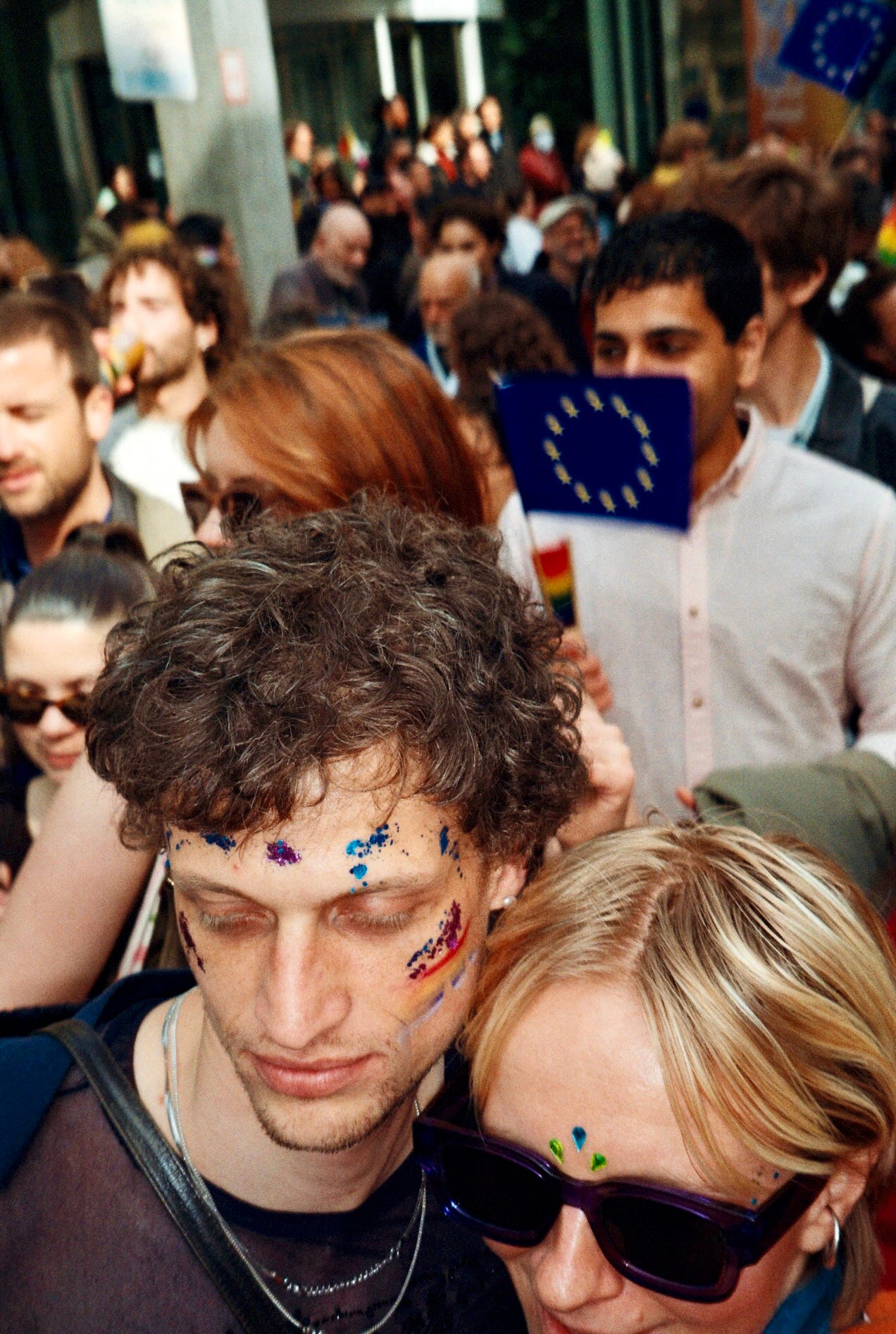
Written the day after Brussels Pride, an undeniably camp affair. Why do I proclaim this with such authority?
1. Sontag’s opening paragraph announces ‘the essence of Camp is its love of the unnatural.’ Is this not the exact word used against queerness? Unnatural.
2. Camp can be offensive, without the intention of harm: Pride is a protest for freedom and an affront to polite society.
3. Pride is serious yet cannot be imagined without laughter: Camp is ‘a mode of enjoyment and appreciation - not judgement.’
4. ‘Camp is an attempt to do something extraordinary’, and so is the global ritual of celebrating the love of all human beings. Offering a new set of standards for coexistence.
5. Pride is Camp. We were Camp. I’m capitalising it because we embodied it.
6. If you search the word online, you will see it’s defined as something ‘so bad, it’s good’, like music at après-ski.
Yesterday our collective body danced to It’s Britney Bitch, Madonna, and Shakira — “icons” of our childhood — as if possessed in a spiritual service.
7. Like Sontag, I am drawn to Camp as easily as I am repulsed by it.
Why do I prefer Brussels Pride to the same party in London? The latter is simply too much. The crowd consumes you and the celebration cascades into a carnival of chaos, descending into debauchery and debris.
8. Camp consists of ‘going against the grain of one’s sex’. Yesterday, you wore shades of blue: icy eyes, a navy knitted crop-top and blue bomber. We exaggerated versions of ourselves and laughed at our gender conforming colours: blue is for boys, pink is for girls, but both can wear see-through mesh.
9. ‘Camp sees everything in quotation marks. [...] It’s not a woman, but a “woman”’.
Yesterday we were innocent “children” playing. Stretching our sense of ourselves through games of flamboyant make-believe. Pantomime: embracing the ‘things-being-what-they-are-not’.
10. Oscar Wilde said, ‘be a work of art, or wear a work of art.’ Do not be a mimic. When a costume becomes a uniform, it stops being fun. Isn’t that the whole point of being queer? We’re open and accepting of everything. Your vanilla-norm-core is also welcome here.
11. Sontag insists that Camp is not only aesthetic. At Pride, we wiggled, laughed, jumped, hugged, licked and bit each other, all to say, ‘thank god we’re alive and I’m proud to be gay’.
12. Allyship itself is very Camp. It isn't imitation, or appropriation. It's flattery. ‘Not all homosexuals have Camp taste [...] but homosexuals, by and large, constitute the vanguard’.
13. And where better to be Camp than in Brussels — the city of Art Nouveau, the style Sontag herself names as the most Camp of all.
So yes, I proclaim it with “authority”.
You can find more of my film photography on my website
All quotes from Susan Sontag’s essay, ‘Notes on “Camp”’ (1964).